


Turning Decades of Mission Knowledge into an AI-Powered Platform
Pioneers is one of the largest global mission organizations in the world, with thousands of workers, mobilizers, and leaders serving across 90-plus countries. They came to us with a problem you'll recognize: decades of valuable content that nobody could actually find when they needed it.
"Reach is finally breaking down 46 years of silos in our organization. For the first time, our workers can discover and reuse resources from across the globe instead of reinventing everything from scratch."
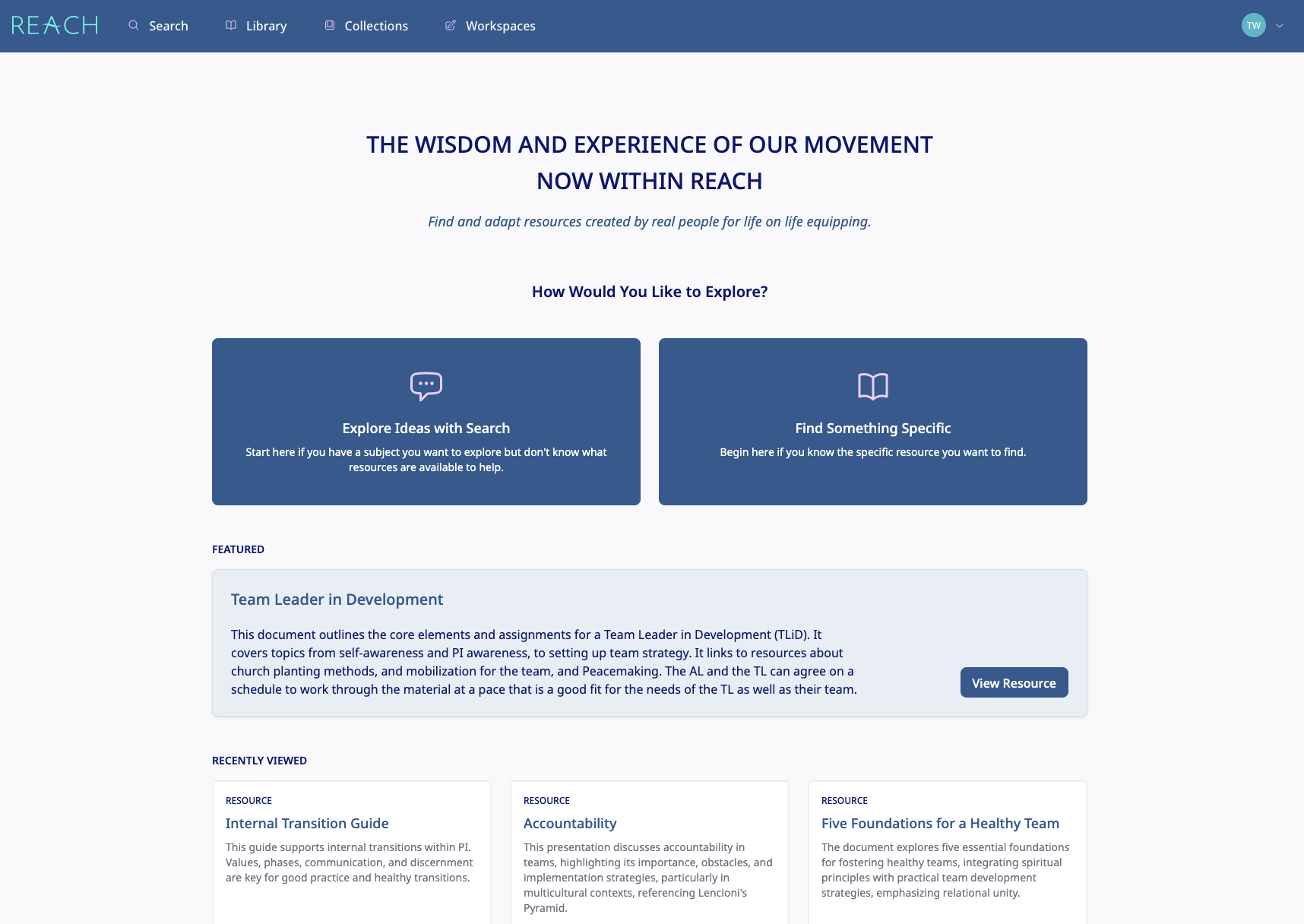
Main dashboard with search and resource options
The Challenge
For years, Pioneers created an enormous library of training materials, cultural research, field reports, leadership content, and policies. But everything was trapped inside PDFs, slides, Google Docs, and folders scattered across regions.
Missionaries on the field spent hours trying to find documents in shared folders. Regional teams built their own mini-libraries that weren't available to others. And some of the best material in the organization went unused simply because nobody knew it existed.
Their vision was simple and bold: a missionary should be able to take articles written in Arabic, understand the core ideas, and reshape them into a leadership workshop in Swahili—all grounded in Pioneers methodology. They didn't need better folders. They needed content that was discoverable, adaptable, and repurposable across regions and languages without replacing the systems they already used.
That's what Pioneers wanted. Here's how we built it.
What We Built Together
REACH is a RAG-enabled, AI-powered knowledge platform built to turn years of scattered documents into something missionaries on the field can actually use.
With REACH, users can ask natural-language questions and instantly search across thousands of documents. The app connects to a vector database and delivers clear answers alongside the most relevant resources. It feels less like searching folders and more like talking to someone who has instant access to every Pioneers document.
The custom RAG engine, built exclusively for Pioneers, ingests almost any file type, extracts the text, creates embeddings, and stores them as vectors for fast, accurate similarity search. That engine matches user queries with the best content the organization has, making it possible to summarize, translate, adapt, and repurpose existing material in completely new ways.
In short, REACH gives missionaries instant access to the full depth of Pioneers' knowledge—and the tools to put it to work.
"Adoption has been organic: people try it, immediately understand it, and start contributing their best resources to the wider community."
The platform includes:
Natural-language search
Returns truly relevant content based on meaning, not just keywords
AI-generated summaries
Staff can evaluate materials quickly without reading everything
Centralized Library
Replaces scattered regional repositories with one searchable source
Collections
Curated topics like team dynamics, formation, and cultural preparation
Workspaces
Prepare training cohorts, events, and onboarding paths
Admin tools
Approve resources, manage metadata, and publish contextual bundles
REACH runs entirely inside Pioneers' Google Workspace, which means authentication and permissions work exactly the way staff already expect.
Built on a Solid Technical Foundation
REACH is a two-layer platform.
The first layer is the web application—a Rails 8 app that handles the user experience. This includes natural-language search, the resource Library, Collections, Workspaces, and admin tools. It runs inside Pioneers' Google Workspace tenant, which means authentication flows through Google OAuth and permissions mirror what staff already have.
The second layer is the data service—a Node.js system that handles ingestion, AI processing, and retrieval. When a document lands in the approved Drive folder, the service extracts text from PDFs, Word docs, slides, spreadsheets, and Google Docs. It then runs each document through an AI pipeline that generates summaries, abstracts, keywords, and language detection using Vertex AI and Gemini. The content gets chunked intelligently, converted into semantic embeddings, and stored as vectors in Pinecone for fast similarity search.
When a user asks a question, the system matches their query against those vectors, retrieves the most relevant chunks, and synthesizes an answer with linked sources. The whole process takes seconds.
Queue-based orchestration handles ingestion reliably, with error tracking and retries for problematic files. The architecture scales as content grows—REACH currently handles thousands of documents across multiple regions and languages.
Technology Stack
Web Application
Ruby on Rails 8
AI & Retrieval Engine
Node.js
Hosting
Google Cloud Run
Database
PostgreSQL
Authentication
Google OAuth
AI Services
Vertex AI + Gemini
Vector Search
Pinecone
Our Process for Building the Right Thing
Many software projects fail not because of bad code, but because teams build the wrong thing. They skip the hard work of understanding the real problem and jump straight to development. Six months later, they have a product that doesn't match how people actually work.
We've learned to avoid this through a disciplined four-phase approach.
Discover
Before writing a single line of code, we spend time with the people who will actually use the software. We study workflows, identify friction, and learn what success looks like in their daily work. The goal is to surface the real problem, not the assumed one.
Define
With the problem clearly framed, we scope an MVP, map user flows, define success metrics, and build an early prototype. Our clients gain clarity on what we're building, why it matters, and how it will work—long before development starts. They walk away with something tangible, not a slide deck full of promises.
Build
Development runs in focused sprints with weekly demos. Clients see working software every week, which keeps decisions grounded in real user needs instead of assumptions made months earlier. Course corrections happen in real time.
Launch
We ship and start learning. User feedback shapes the roadmap. Performance monitoring catches issues early. And because the foundation is solid, the product can grow as organizational needs evolve.
This approach shaped a key architectural decision on the Pioneers project: instead of replacing systems, we layered intelligence on top of the tools they already used.
What REACH Makes Possible
REACH gives Pioneers staff a fundamentally different way to work with organizational knowledge.
Missionaries on the Field
Can now search across thousands of documents in seconds instead of digging through folders or emailing colleagues. When preparing someone for the field, they can pull together relevant cultural research, training materials, and policy documents without spending half a day hunting.
"For the first time, our people can easily access resources created in other regions. They no longer have to reinvent everything from scratch—and they're discovering high‑quality tools they never even knew existed."
Leaders
Can use Workspaces to build training cohorts, shape onboarding paths, and create repeatable processes for events. Instead of starting from scratch every time, they can curate and adapt existing resources.
"When we introduced Reach to a small group of 25 leaders representing 14 regions, the response was immediate. For many, it was the first time they'd ever had access to resources created outside their own area. The realization that they didn't have to invent everything from scratch was both a relief and a catalyst for engagement."
Trainers
Can prepare thematic series, develop conference content, and compare resources quickly using AI-generated summaries. Content that once sat dormant now becomes part of active learning.
"Our organization has operated in silos for 46 years, with 18 different gateways into the field and very little cross‑regional sharing. Reach is becoming a key part of breaking those silos down—suddenly a tool developed in one part of the world can be discovered and reused globally."
And because REACH tracks what staff are searching for, leadership gains visibility into knowledge gaps and where to invest in new materials.
Pioneers now has a solid infrastructure. The foundation we built together opens the door to chat-style assistants, guided learning paths that adapt to role or region, content analytics, and integration with CRMs or learning management systems.
What This Means for Your Organization
If your team spends hours hunting for documents, maintaining duplicate libraries, or overlooking your best materials, you're facing the same challenge Pioneers solved. Here's what we learned.
Large content libraries need RAG
Keyword matching fails when people don't know the exact words to search for. RAG understands meaning—surfacing relevant content even when users don't remember what it was called.
Meet people where they already work
REACH lives inside Google Workspace. Same authentication, same permissions. The learning curve is minimal because the context is familiar.
Start with discovery, not technology
We understood how users actually search for content before writing code. AI projects that skip this step build impressive technology nobody uses.
Build infrastructure, not just features
Pioneers didn't just get a search tool—they got a foundation for chat assistants, learning paths, and content analytics they can add over time.
You don't need to migrate to modernize
Pioneers kept Google Drive and their existing folder structures. The AI layer made what they already had more useful.
If any of this sounds familiar, we should talk.
We build AI-powered solutions for mission-minded organizations, and we'd welcome a conversation about what's possible in your context.
Schedule a Call With Our Team