


Turning a Validated Methodology into a Live SaaS Product
Alignify came to us with something rare: a product thesis that had already been tested in the real world. The team had spent years working directly with church leaders, surveyed 300+ pastors about how they set and track goals, and run live workshops where ministry staff described—in their own words—why every goal-setting system they'd tried had failed them.
The insight was clear. The methodology was proven. The software didn't exist yet.
Alignify is a lightweight people management platform built around a single weekly behavior: the check-in. It helps small teams stay aligned by anchoring goals, updates, and meetings in one system. Churches and nonprofits are the first market, with a broader small-team vision beyond that.
Hillcraft built it from idea to live beta.
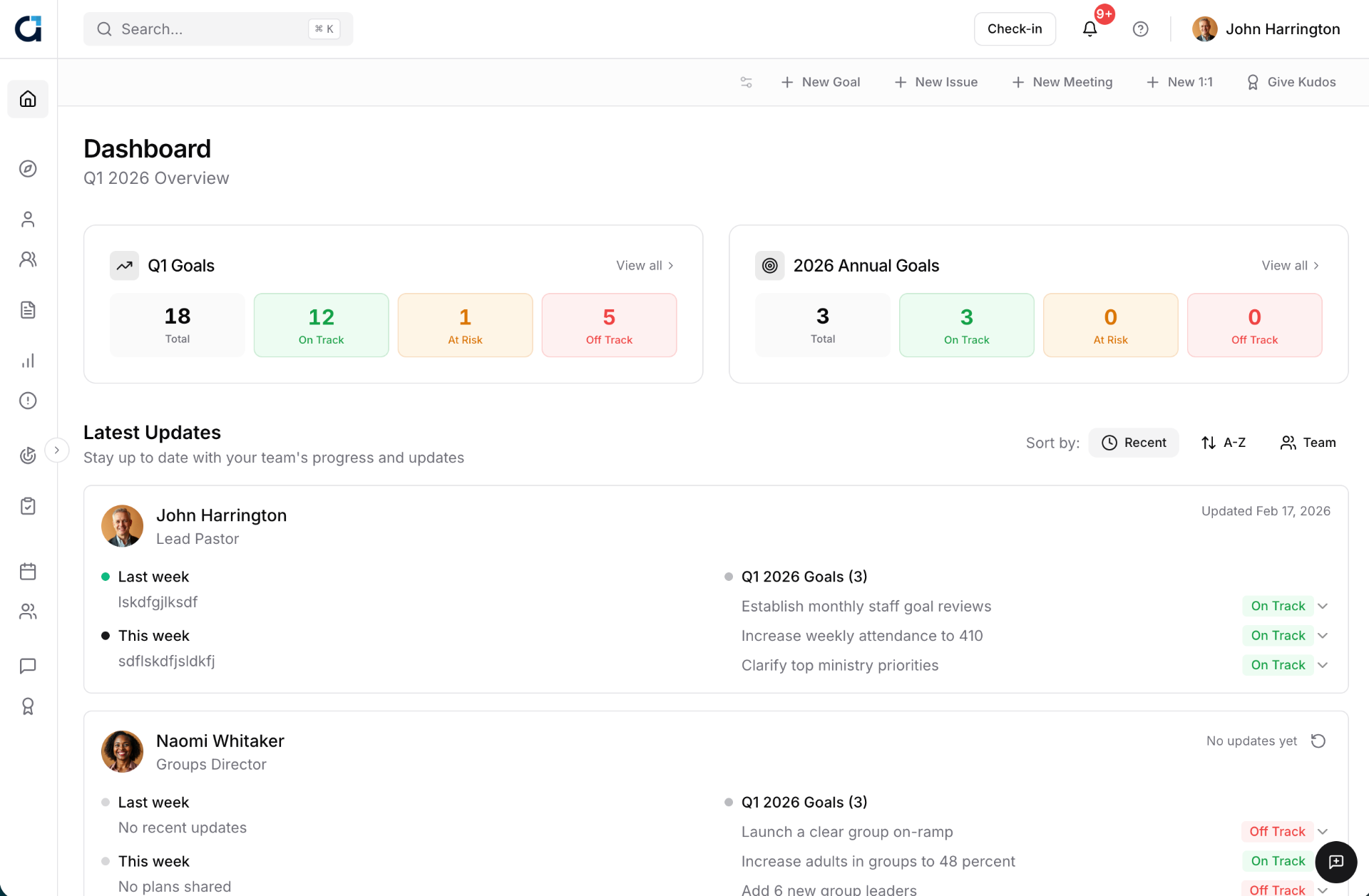
Alignify's manager dashboard — goal status, team updates, and weekly check-ins at a glance
300+
Pastors Surveyed
45%
Lacked Written Goals
53%
Found Systems Ineffective
The Problem
Most teams don't fail because they lack goals. They fail because those goals disappear between meetings.
Updates scatter across Slack, email, and hallway conversations. Managers either chase status or operate on assumptions. Problems surface late. Talent burns out quietly. Progress drifts off course. And the existing tools designed to fix this—EOS/Ninety, Lattice, 15Five, Tability—are built for larger organizations with dedicated ops teams, complex reporting needs, and the appetite for heavyweight frameworks.
Small teams need something fundamentally different. Especially churches.
Research with 300+ pastors made the scale of the problem concrete. 45% lacked clear written goals. 53% said their current goal systems weren't effective at driving focus. 39% rarely discussed goals in any meeting. And when those numbers were pressure-tested through live workshops with church leaders, the feedback was even more pointed.
"Our strategic plan is just ideas on a page. No measurable goals. No plans to accomplish them."
— Lead Pastor
"Our staff are lone rangers—making goals without communicating with each other."
— Worship Pastor
"Every week kinda goes haywire and goals fall by the wayside when urgent needs take over."
— Associate Pastor
These weren't theoretical user personas. These were the people who would become early users.
The product thesis that emerged was specific: alignment breaks in meetings, not dashboards. The solution wasn't better goal tracking. It was making goals show up automatically in the meetings teams already have, anchored by a weekly check-in that takes about a minute to complete. The product had to be radically simple—opinionated enough to drive behavior change, lightweight enough that adoption didn't require training or mandates.
What We Built
Alignify is built around one core loop: goals flow into weekly check-ins, check-ins flow into meeting agendas, and meetings drive decisions.
Every piece of the product serves that loop.
Weekly Check-Ins
Team members submit a short update covering goal progress, wins, blockers, and a morale signal. It takes about 60 seconds. That check-in becomes the raw material for everything else—the manager's situational awareness, the meeting agenda, and the running record of how the team is actually doing week over week.
Manager Snapshot
Check-in data rolls up across the team. Leaders can see goal status, blockers, and morale trends in one place without chasing updates through multiple channels. The insight is contextual—designed to help leaders prepare for conversations, not generate reports nobody reads.
Meeting Hub
Agendas auto-populate from check-in data. This is where the product thesis lives inside the software. Goals don't sit in a separate dashboard that people forget to check. They show up in the meetings that already exist, which means alignment becomes part of the weekly rhythm instead of a separate compliance exercise.
Goal Tracking
Simple status updates with clear ownership and deadlines. No complex hierarchies or nested OKR structures.
People Profiles
A running record of each person's goals, check-ins, and meeting context—the system of record for the manager-employee relationship.
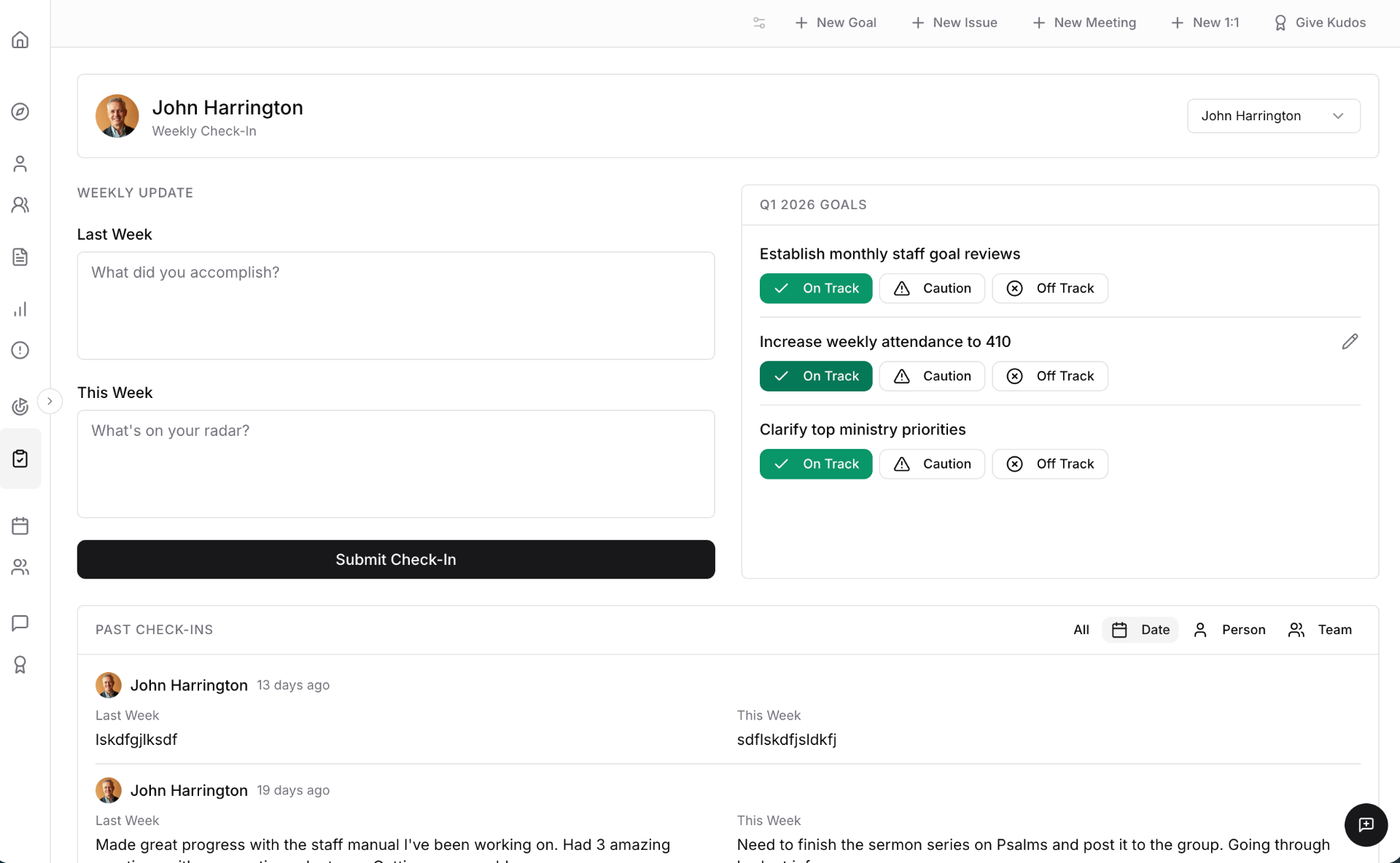
The weekly check-in — 60 seconds to update progress and flag blockers
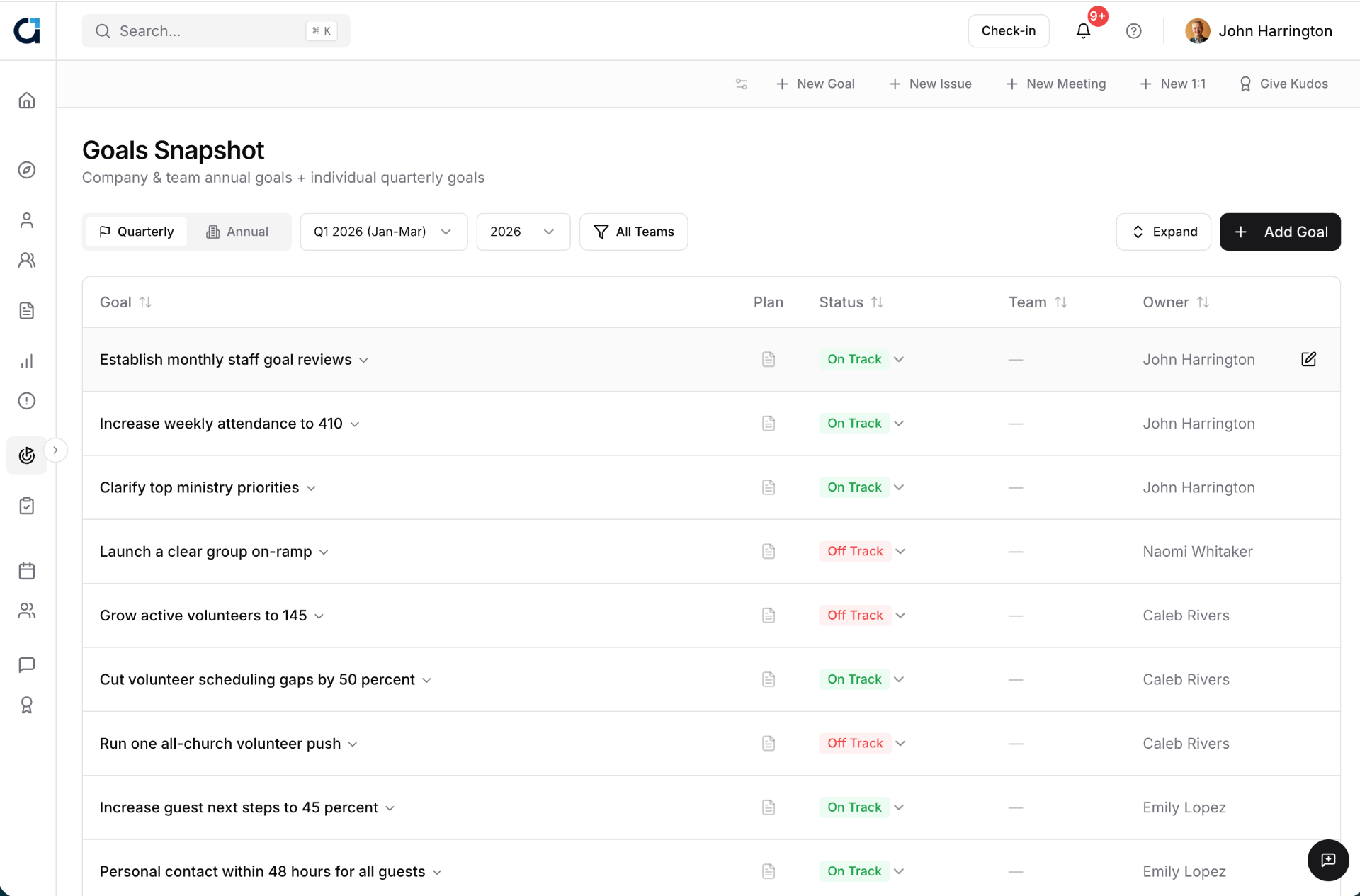
Goals snapshot — quarterly and annual goals with status and ownership
We made deliberate choices about what not to build. Alignify is not an HR suite, not a dedicated OKR tool, not a communications platform, and not a task manager. Every feature request got tested against one question: does this serve the weekly check-in loop? If the answer was no, it didn't make the cut.
That discipline is what keeps the product simple enough for a 15-person church staff to adopt without a training session.
Email-First Architecture
Rather than requiring daily logins, Alignify delivers weekly reminders and check-in summaries via email. The product earns its place in the weekly rhythm before users ever open the app. The principle: meet people where they already are.
Technology Stack
Web Application
React + TypeScript
Backend & API
Supabase
Hosting
Vercel
Database
PostgreSQL
Authentication
Email + Magic Link
Email Delivery
Resend
How We Got There
This project started with more market validation than most startups have after a year of operation. That changed how we worked together.
Discovery That Was Already Done
Most projects start with weeks of discovery to understand the market and the user. This one started with years of direct experience in the church leadership space, hundreds of survey responses, and live workshop feedback from the exact audience the product would serve. Pastors had described their frustrations with goal-setting in language that no amount of user interviews could manufacture.
Our discovery focused on translating that knowledge into product decisions. We studied nine direct competitors and mapped where each one overserved or underserved the small team market. We identified the specific gaps Alignify could own: meeting integration, radical simplicity, and a weekly cadence built for teams of 5–50 people.
Scoping With Discipline
The "intentionally not building" list was as important as the feature set. We scoped an MVP tightly around the core loop—goals, check-ins, meetings—and defined success metrics tied to actual behavior change rather than feature delivery.
The questions that mattered weren't about shipping features. They were about whether the product would change how people work: Would team members complete check-ins consistently? Would managers actually use the snapshot view before meetings? Would auto-populated agendas make meetings better?
Building Fast Without Cutting Corners
Development ran in focused sprints with working software visible throughout. The Alignify team saw real product at every stage, which kept decisions grounded in how things actually felt rather than how they looked in wireframes.
The build reflected the product philosophy at every level. The check-in had to take 60 seconds—if it felt like a burden, the whole thesis would collapse. The meeting hub had to populate agendas without requiring managers to do extra setup. Email summaries had to be useful enough to stand on their own, not just notification noise.
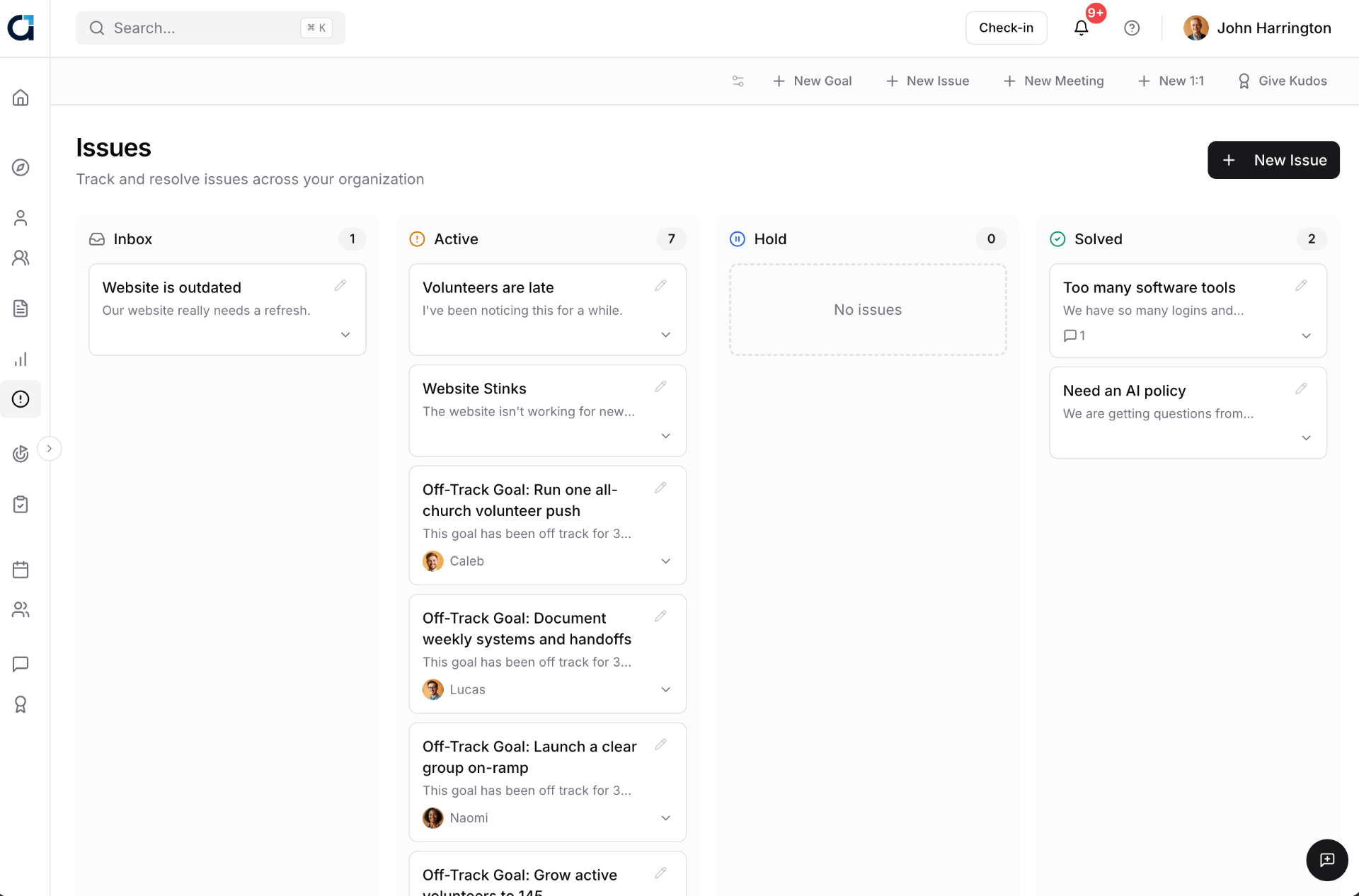
Issues board — surface and resolve blockers before they derail goals
What Happened
The beta launched with 20 churches. Each one received hands-on onboarding, including sitting in on early team meetings to observe adoption patterns and catch friction points firsthand.
The beta was structured to validate specific behavioral assumptions, not just collect feedback. Participating churches were placed across multiple pricing tiers to test price sensitivity. Check-in completion rates were tracked weekly to see whether the habit stuck or decayed after the first few weeks. Manager engagement with the snapshot view and meeting hub was monitored to understand whether leaders actually changed how they prepared for meetings.
That hands-on approach during beta generated the kind of insight that analytics alone can't provide. Watching how a children's pastor interacts with a check-in prompt on a Tuesday morning is different from reading a usage report on Friday. Those observations shaped product adjustments in real time.
What This Changed
For Church Leaders
Pastors and ministry leaders get a current view of what's actually happening across their team each week. They stop chasing status updates. They walk into staff meetings with context already built, which means those meetings produce decisions instead of recaps. The "lone ranger" dynamic that multiple pastors described—staff working in silos, making goals without communicating—starts to break down when goals become visible to the whole team.
For Staff and Team Members
The weekly check-in gives people a structured moment to reflect on progress, flag blockers, and share what's ahead. It takes about a minute, and it creates a sense of being seen and heard that many small team members describe as missing from their work. In ministry contexts where weeks routinely "go haywire," having a consistent moment of reflection helps teams hold onto priorities even when the urgent crowds out the important.
For the Organization
Goals move from leadership-only documents into the weekly rhythm of the team. Problems surface early—when they're small and fixable—instead of late when they've become crises. The 90-day goal cycle that pastors described as "freeing, not constraining" gets built into the system's natural cadence.
What We Learned
Domain expertise is the most valuable accelerant in early-stage development
Years of direct experience in the church leadership space shaped every product decision. The 60-second check-in constraint, the email-first architecture, the meeting-centric design—none of these came from competitive analysis or best practices. They came from deep knowledge of the people the product would serve. When that kind of knowledge exists before development starts, the team's job is to honor it with disciplined execution, not second-guess it with generic frameworks.
The 'not building' list drives speed as much as the feature set
Alignify's radical simplicity is its primary competitive advantage. That simplicity only exists because we maintained discipline about what didn't belong in the product. Saying no to features that would have been easy to justify—but would have diluted the core experience—is what made it possible to reach beta as fast as we did.
Build for behavior change, not feature delivery
The entire product exists to create one new habit: the weekly check-in. Everything else supports that behavior. This focus made development faster because every decision had a clear filter. It made testing more meaningful because we were measuring behavior adoption, not feature usage. And it made the beta more valuable because we could tell quickly whether the core thesis was working.
Get to real users before the product feels 'ready'
Workshop feedback from actual pastors shaped the product more than any competitive analysis or strategy document. Real users in real workflows surface what matters—and waiting for perfection wastes time. The beta generated insights that months of additional development never would have.
Meet users where they already work
Alignify's email-first approach means the product becomes part of the weekly rhythm without requiring daily logins or training sessions. In the church market especially, where staff wear multiple hats and platforms compete for attention, the products that win are the ones that fit into existing workflows rather than demanding new ones.
Have the expertise? Let's build the product.
Hillcraft helps teams turn validated ideas into focused, well-built software products. If you have the domain expertise and the market insight, we'll help you build the right thing—and ship it.